


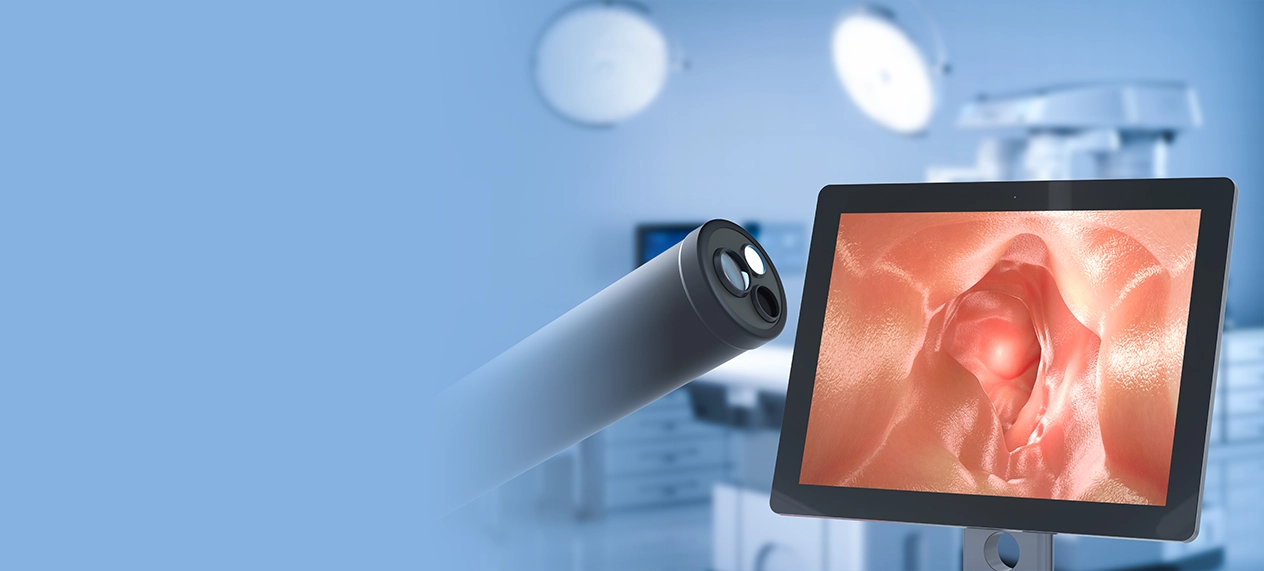
Endoscopy is a diagnostic procedure that uses a thin, flexible tube with a camera on its end to look inside the patient’s body and examine the organs directly. Endoscopy can help to diagnose and assess various conditions, including cancer. It is commonly used to check for cancers of the esophagus, stomach, colon, airways, cervix and bladder. Endoscopy also allows a doctor to remove a tissue sample for biopsy, which is a confirmatory test for cancer. Upper endoscopy can take anywhere between 20 and 30 minutes.
Endoscopy is a medical procedure that helps doctors to look at various organs and structures within the body. This helps to identify any abnormal growths, lesions, or inflammation. Endoscopy can also help doctors to carry out a biopsy by providing detailed imaging guidance to extract the tissue sample with added precision. It is useful in detecting precancerous changes or polyps that can develop into cancer later, making it an important tool for early cancer screening.
During the procedure, doctors insert a narrow, flexible tube through a natural opening in the patient’s body, such as the mouth, urethra, or rectum. This does not require any cuts or incisions. The tube is carefully guided towards the affected organ or area. The camera fitted on the head of the tube helps to see all the details, and pictures can also be taken to be shared with your medical team later.
To explore different types of endoscopy procedures available for cancer detection, get in touch with our expert team at BMCHRC.
| Common endoscopic test | Cancer type | Area examined | What it can find |
| Colonoscopy | Colorectal cancer | Colon and rectum | Polyps, abnormal growths, bleeding, inflammation, and early cancers in the colon and rectum. |
| Upper endoscopy (EGD) | Esophageal cancer | Esophagus, stomach, and duodenum | Narrowing, ulcers, abnormal tissue, and suspicious lesions in the food pipe. |
| Upper endoscopy (EGD) | Stomach (gastric) cancer | Esophagus, stomach, and duodenum | Ulcers, abnormal growths, inflammation, and early cancers in the stomach lining. |
| Capsule endoscopy or enteroscopy | Small-intestinal cancer | Small intestine (small bowel) | Tumors, polyps, bleeding sources, and abnormalities in parts of the small bowel that standard upper endoscopy may not reach. |
| ERCP or endoscopic ultrasound (EUS) | Pancreatic and bile-duct cancer | Pancreas and bile ducts | Blockages, abnormal ducts, masses, and tissue that can be sampled; these tests are often combined with CT or MRI. |
| Bronchoscopy | Lung cancer | Windpipe and airways | Tumors or abnormal airway tissue; samples can be taken for diagnosis. |
| Cystoscopy | Bladder cancer | Bladder and urethra | Tumors or abnormal tissue inside the bladder. |
Colonoscopy is a diagnostic test that allows the doctors to look inside the colon and the rectum. The endoscope is passed through the rectum and carefully moved along the large intestines. As this happens, the diagnostic camera helps to generate live images on screen, allowing doctors to see everything clearly.
Colonoscopy is one of the most important tools for detecting the early traces of colorectal cancer, such as precancerous polyps, and can also play a role in cancer prevention.
The National Polyp Study published in the New England Journal of Medicine found that removal of precancerous adenomatous polyps during colonoscopy helped to lower deaths related to colorectal cancer by 53 percent. Screening for colorectal cancer is recommended for asymptomatic adults who are 45 years or older.
Upper endoscopy is a procedure that the doctor used to look at the upper part of the digestive tract, which involves the esophagus, stomach, and first part of the small intestine. It is also known as esophagogastroduodenoscopy or EGD. The tube is passed through the mouth and then carefully moved down, towards the throat. Conditions that upper endoscopy can help to detect include ulcers, inflammation, abnormal growths, or precancerous changes in the tissue.
Doctors may recommend it for patients who are experiencing symptoms like difficulty in swallowing, heartburn, anemia, upper abdominal pain, nausea, vomiting, or bleeding. You will be asked to fast for a couple of hours before the procedure to make sure your stomach is empty.
Some people may be given sedation. It is normal to experience mild soreness in the throat after the procedure.
Capsule endoscopy is a type of endoscopy that allows doctors to examine the small intestines from within. Instead of a long, narrow tube, this uses a tiny, swallowable camera, about the size of a vitamin pill, which takes multiple images as it passes through the digestive tract. The patient is required to wear a belt on their waist with a tiny recorder fitted on it. The images taken by the camera are sent to this recorder wirelessly.
Capsule endoscopy can help in detecting small intestinal tumors, polyps, gastrointestinal stromal tumors, neuroendocrine tumors, certain vascular abnormalities, and conditions like Crohn’s disease. However, unlike traditional endoscopy, this cannot be used for performing a biopsy. So, in case the doctor finds anything abnormal, the patient might need some other procedure as well.
Before the procedure, you will need to fast for a couple of hours. A laxative may be given to ensure your small intestine is clean. It usually takes about 8 hours, and you will be required to wear the monitor for that span. Capsule endoscopy is completely painless, and no sedation is required.
Enteroscopy is an endoscopic procedure that helps to examine the small intestine in more detail compared to an upper endoscopy scan. In this case, the endoscopic tube is a little longer and more flexible. It can be passed into the body via the mouth or through the rectum. Endoscopy can have different variations. For instance, doctors may use balloons or a spiral overtube to move the scope forward through various bends in the intestine. The former is known as balloon-assisted endoscopy, and the latter is known as deep endoscopy.
Enteroscopy not only allows doctors to diagnose a condition but also to perform a biopsy or to treat certain abnormalities. Doctors usually recommend it for patients experiencing small intestine bleeding, narrowing, polyps, or suspected tumors. It may also be recommended if the doctors find any abnormality during capsule endoscopy.
You will need to fast for a couple of hours before the procedure. This, however, depends on whether the scope will be introduced orally or through the rectum. The patient is given sedation or anesthesia, and it can take an hour or more. It is normal to feel abdominal bloating and discomfort after the procedure, which go away on their own.
ERCP uses a combination of upper endoscopy with X-ray. This is done to examine the pancreas and the bile duct. The tube is inserted into the body through the patient’s mouth and passed through the esophagus, stomach, and duodenum. A tiny tube known as a catheter is used for injecting dye into the ducts. This helps to generate clear images.
Apart from diagnosing various conditions, ERCP can also be used for treating some of them, as doctors can use special tools to address the problems and collect tissue samples for biopsy during the procedure. It is usually recommended for people with leaking, narrowed, or blocked ducts, infection, acute pancreatitis, or tumors.
You will need to refrain from eating or drinking anything for a couple of hours before the procedure. The patient is given mild sedation or anesthesia to avoid discomfort.
Endoscopic ultrasound uses a combination of endoscopy and ultrasound to generate detailed images of the digestive tract and the surrounding organs and tissues. Doctors use a thin, flexible tube fitted with a tiny ultrasound device at its end. This is passed into the body through the mouth or anus. The device produces sound waves that help to create detailed images of the linings and walls of the digestive organs, pancreas, bile ducts, gallbladder, liver, and lymph nodes.
During endoscopic ultrasound, doctors may pass a fine needle to collect a sample of tissues for biopsy. This is known as fine needle aspiration or fine needle biopsy.
You will need to fast for at least 6 hours before the procedure. The procedure will be done under the influence of sedation or anesthesia and takes less than an hour. If needle aspiration is done, it may take longer. It is normal to experience soreness in your throat after the procedure.
Bronchoscopy is a type of endoscopy that allows a doctor to examine a patient’s airways and detect problems with the lung. The device used in this case is a bronchoscope, which is very similar to an endoscope. It is introduced into the body via the nose or the mouth and then carefully moved down the throat into the airways.
Doctors usually recommend bronchoscopy to patients who have been experiencing a persistent cough, traces of blood and mucus, or repeated lung infections, or if the patient’s X-ray or CT scan shows an abnormality. During the procedure, doctors can also take samples of tissues or fluid for biopsy. Also, if the doctor suspects anything unusual, they may simultaneously use an ultrasound probe to assess lymph nodes surrounding the airway.
Before the procedure, you will need to fast for at least 6 to 12 hours. Doctors will numb your airway by giving sedation. It is normal to have a sore throat and cough after the procedure.
Cystoscopy is a type of endoscopic procedure that makes it possible for doctors to look inside the bladder and urethra. During the procedure, doctors use a very thin scope fitted with a camera that is gently inserted through the urethra and moved towards the bladder, which is filled with fluid to ensure better quality of pictures.
Cystoscopy can take anywhere between 5 and 20 minutes. The procedure is usually recommended for detecting cancer of the bladder or urethra. Doctors may also recommend it to people who experience symptoms like blood in urine and repeated bladder infections. Doctors may simultaneously perform a biopsy if there is any unusual lesion or growth.
During the procedure, doctors use a special anesthetic gel to numb the urethra. In case a biopsy is also done, doctors give sedation or general anesthesia. It is normal to feel slight discomfort after the procedure. Some patients might even experience a strong urge to urinate or a burning sensation during urination.
Endoscopy is a medical procedure that helps doctors to look at various internal organs and structures without making an external incision on the body. This involves the use of an endoscope that is introduced into the body through the natural openings, such as the nose, urethra, mouth, and rectum. Apart from cancer, endoscopy can be used to diagnose other conditions as well. Get in touch with our experts at BMCHRC to know more about these endoscopic procedures.
Endoscopy is a procedure in which doctors insert a tiny flexible tube fitted with a camera and a light source into the patient’s body. This is done to examine internal organs for any abnormality.
Endoscopy can help to detect abnormal masses, lesions, or changes that may suggest the person has cancer, but it cannot help to detect cancer. For this, a biopsy is needed.
There are several different types of cancers that endoscopy can help to detect. These include esophageal cancer, stomach cancer, colon cancer, colorectal cancer, lung cancer, bladder cancer, throat cancer, pancreatic cancer, etc.
Endoscopy is not usually painful, although there might be slight soreness and discomfort. Most of the procedures are done under sedation or anesthesia.
Some common risks of the endoscopy procedure are bleeding, soreness, and reaction to sedation. Serious complications are quite rare.
References
National Cancer Institute. Colonoscopy Reduces Risk of Death from Colorectal Cancer in High-Risk Patients: https://www.cancer.gov/types/colorectal/research/colonoscopy-reduces-deaths
US Preventive Services Task Force. Screening for Colorectal Cancer: US Preventive Services Task Force Recommendation Statement. JAMA. 2021;325(19):1965-1977:
https://jamanetwork.com/journals/jama/fullarticle/2779985
Medical Disclaimer
This article is for educational purposes only. It is not medical advice and does not replace diagnosis or treatment by a qualified doctor. Tests, results and costs vary from person to person, and no outcome can be guaranteed. Please consult a registered medical practitioner about any symptom or before deciding on tests.
Dr. Tej Prakash Soni
Senior Consultant
Meet the Doctor
 +91-8440049999
 Careers
 Donate
 Book an Appointment
 Tele-Consultation
 Patient Portal


